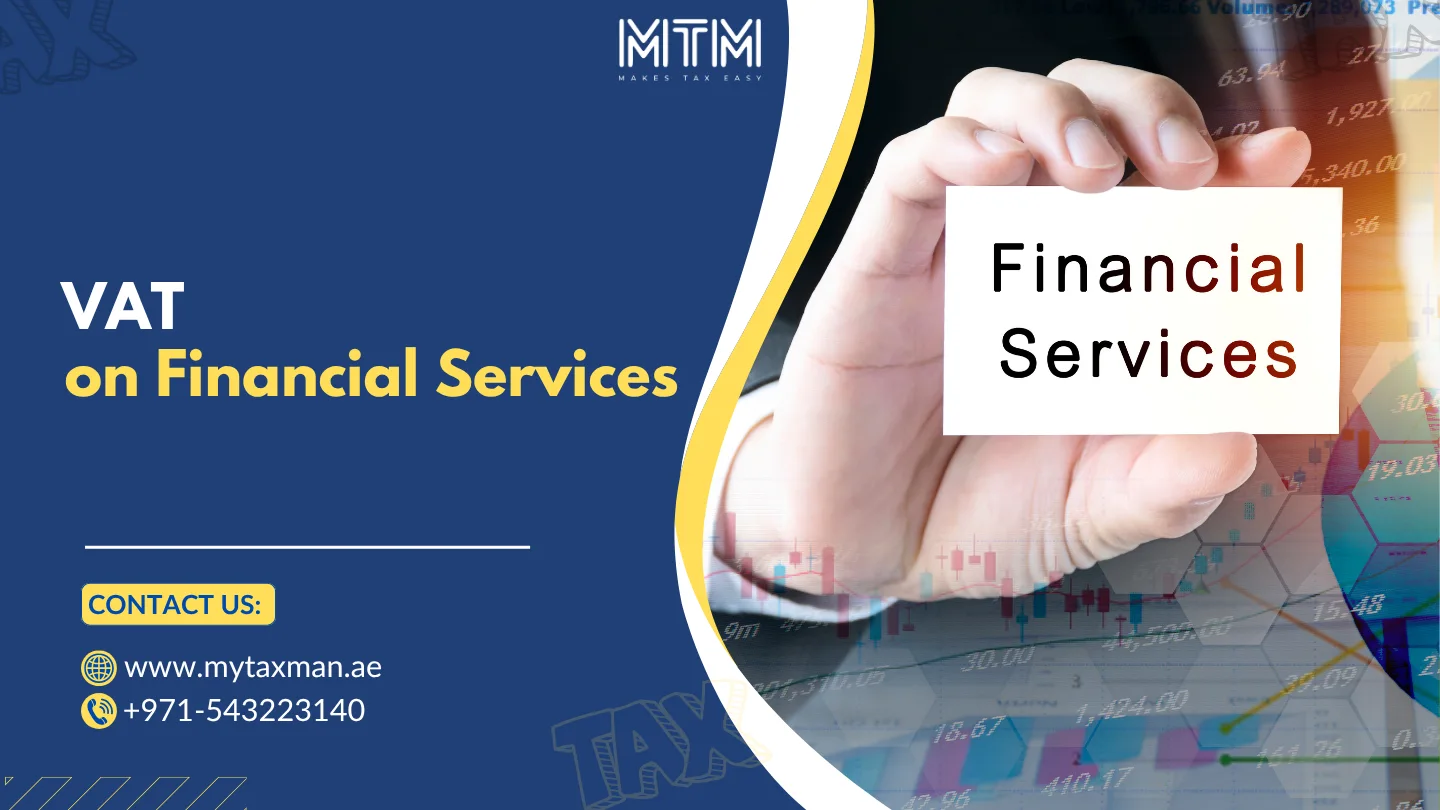
VAT on Financial Services in the UAE demands careful navigation, as the 5% tax applies selectively to banking, insurance, and investment activities under Federal Decree-Law No. 8 of 2017. Businesses must distinguish between taxable fees, exempt margins, and zero-rated supplies to avoid penalties from the Federal Tax Authority (FTA). This guide breaks down the essentials, helping UAE firms achieve seamless VAT compliance while optimising operations.
In the UAE’s dynamic economy, VAT on Financial Services shapes how banks, insurers, and fintech firms operate amid evolving FTA guidelines. With the financial sector contributing significantly to GDP, understanding the differences between margin-based products and taxable explicit fees is crucial for compliance and input tax recovery. My Taxman, your trusted VAT Agent in the UAE, simplifies this through expert VAT Consultancy, ensuring businesses like yours stay audit-ready and penalty-free.
Table of Contents
ToggleDefining Financial Services under UAE VAT
UAE VAT law defines financial services broadly as dealings in money, credit provision, or equivalents like deposits, loans, and securities under Article 42 of the Executive Regulations. This includes interest-based lending, money transfers, currency exchange, insurance contracts, and investment brokerage. Not all qualify uniformly fee-charging services like commissions hit the standard 5% VAT, while implicit margin activities, such as loan interest spreads, remain exempt.
Portfolio management and trustee services also fall here, with VAT treatment hinging on remuneration type. For instance, explicit advisory fees are taxable, but fund management via margins is exempt. Businesses must classify accurately to determine registration thresholds (AED 375,000 taxable supplies) and invoicing rules.
VAT Treatment Categories
Financial services are split into three VAT categories: standard-rated (5%), exempt, and zero-rated, per the FTA’s VATGFS1 guide. Standard-rated covers explicit charges like brokerage fees, deposit administration, or mutual fund subscriptions, allowing input VAT recovery. Exempt supplies, dominant in core banking, include margin-based loans, deposits, and Islamic finance products like Murabaha without separate fees, no VAT charged, but no input recovery either.
Zero-rated applies to exports or international services, such as cross-border reinsurance, requiring FTA proof, like customs documents. Islamic finance gets special leeway: profit rates in Sukuk or Ijarah mimic margins for exemption, but handling fees trigger 5% VAT. Misclassification risks audits, underscoring the need for VAT compliance audits.
Key Exemptions and Special Rules
Core exemptions shield margin-remunerated services, like bank lending where profit is the interest spread, from VAT to avoid tax on tax cascades. Insurance against natural disasters or regulated funds also qualifies, as do inter-company supplies without fees. Recent updates exempt virtual assets and investment funds, easing fintech burdens but blocking input claims.
Islamic products align via “effective margin” calculations, treating profit rates as implicit fees for exemption. Swaps, derivatives, and credit default products are exempt if margin-based, but advisory elements are taxable. Businesses must apportion mixed supplies using FTA-approved methods for partial recovery
Registration and Thresholds
Mandatory VAT registration kicks in at AED 375,000 annual taxable supplies (excluding exempt), with voluntary options below for input recovery. Financial firms often hit this via fee-based arms, requiring EmaraTax portal setup and quarterly filings. Free zone entities follow mainland rules unless qualifying for simplified compliance.
Post-registration, issue VAT invoices for taxable supplies, detailing fees separately. Groups can register jointly to streamline, but related-party exemptions apply only sans explicit charges.
Compliance Obligations
VAT compliance for financial services mandates accurate record-keeping for four years, including transaction ledgers proving margin vs. fee splits. File returns quarterly via FTA’s system, reconciling outputs with inputs; late filings incur 100 AED/month penalties plus 5% annual interest. Audits scrutinise apportionment ratios for mixed activities use direct or residual methods per Public Clarification VATPFS10.
Health checks, voluntary disclosures, and penalty waivers are vital for errors. VAT Agents in UAE like My Taxman handle filings, FTA communications, and audit defense, ensuring seamless adherence.
Input Tax Recovery Strategies
Recover input VAT on taxable overheads like software or office costs, but apportion for exempt activities using turnover-based ratios. For banks, this means segmenting fee vs. margin revenues quarterly. Blocked credits apply to exempt passenger transport or entertainment, irrelevant here but noteworthy for bundled services.
Optimize by restructuring fees or outsourcing to taxable consultants. My Taxman’s VAT Consultancy maximizes recoveries, reducing effective costs.
Recent FTA Updates and Risks
As of 2026, FTA emphasises e-invoicing integration for financials and stricter zero-rating proofs. Non-compliance risks AED 20,000 fines per violation, escalating to imprisonment for evasion. Fintechs face scrutiny on crypto services, now exempt but documentation-heavy.
Stay proactive with FTA guides like VATGFS1 and webinars.
Role of VAT Agents and Consultants
A VAT Agent in UAE streamlines registration, returns, and audits, acting as your FTA liaison. VAT Consultancy from firms like My Taxman covers corporate tax alignment, transfer pricing, and due diligence for financial deals. Beyond VAT compliance, we offer accounting, CFO services, and holistic valuation support for growth.
Ready for expert guidance?
Mastering VAT on Financial Services empowers UAE businesses to thrive compliantly amid FTA’s framework. From exemptions to recovery, proactive VAT compliance safeguards your operations.
Contact My Taxman today at +971-543223140 for VAT Consultancy, registration, and full tax solutions book a free consultation today!
FAQS for VAT on Financial Services
Are financial services subject to VAT in the UAE?
In the UAE, financial services are generally treated as exempt supplies under the VAT Law, particularly where consideration is implicit, such as margin-based income (e.g., interest on loans). However, certain financial services that charge explicit fees, commissions, or service charges may be subject to VAT at the standard rate of 5%. Businesses must carefully assess whether income is margin-based or fee-based to determine the correct VAT treatment. The Federal Tax Authority (FTA) requires proper classification to ensure accurate VAT reporting within each Tax Period and to avoid Administrative Penalties for misapplication of VAT rules.
Which financial services are exempt from VAT in the UAE?
Financial services that involve implicit consideration, such as interest earned on loans, margin-based foreign exchange transactions, and certain insurance-related activities, are typically exempt from VAT in the UAE. Exempt supplies do not allow recovery of input VAT, which directly impacts cost structures. The Federal Tax Authority (FTA) mandates that businesses clearly distinguish exempt financial services from taxable ones when filing VAT returns. Proper documentation and classification are essential to ensure compliance and avoid disputes during audits. Failure to correctly categorise exempt supplies may result in adjustments, penalties, or denial of input VAT recovery.
Are banking fees and commissions taxable under UAE VAT?
Yes, banking fees and commissions are generally subject to VAT at 5% in the UAE when they are explicitly charged to customers. Examples include account maintenance fees, transaction charges, and advisory fees. Unlike margin-based income, these services are considered taxable supplies under UAE VAT Law. Financial institutions must include such income in their VAT returns and account for output VAT accordingly. The Federal Tax Authority (FTA) requires accurate invoicing, proper TRN usage, and timely filing within the applicable Tax Period. Non-compliance, including underreporting taxable fees, may lead to Administrative Penalties.
Can financial institutions recover input VAT in the UAE?
Input VAT recovery for financial institutions in the UAE depends on whether the underlying supplies are taxable or exempt. VAT incurred on costs directly related to taxable financial services (e.g., fee-based services) is generally recoverable. However, input VAT linked to exempt financial services is not recoverable, which increases operational costs. Where expenses relate to both taxable and exempt supplies, businesses must apply an apportionment method in line with Federal Tax Authority (FTA) guidance. Accurate allocation and documentation are critical, as incorrect recovery may result in reassessment and Administrative Penalties during FTA audits
What is the VAT rate applicable to financial services in the UAE?
The standard VAT rate in the UAE is 5%, which applies to financial services that involve explicit fees or commissions. However, many financial services remain exempt where the income is derived through margins rather than direct charges. Businesses must evaluate each transaction type to determine whether VAT applies. The Federal Tax Authority (FTA) requires VAT-registered entities holding a valid Tax Registration Number (TRN) to apply the correct rate and report it accurately in their VAT returns. Misclassification of services may result in compliance risks, including penalties and disallowed input VAT claims.
Is VAT applicable on loan interest in the UAE?
Loan interest in the UAE is generally treated as an exempt financial service under VAT Law because the consideration is implicit rather than explicitly charged. As a result, no VAT is applied to interest income earned by financial institutions. However, any separate fees linked to loan processing, administration, or early settlement may be subject to VAT at 5%. The Federal Tax Authority (FTA) requires businesses to clearly distinguish between exempt interest income and taxable service fees when filing VAT returns for each Tax Period. Incorrect classification may result in reassessment and Administrative Penalties.
Are foreign exchange services subject to VAT in the UAE?
Foreign exchange services in the UAE are typically exempt from VAT when the income is earned through margins between buying and selling currency rates. However, if a financial institution charges explicit service fees or commissions for currency exchange transactions, such charges are subject to VAT at the standard rate of 5%. The Federal Tax Authority (FTA) requires proper identification of margin-based versus fee-based income to ensure correct VAT treatment. Businesses must maintain adequate records and report taxable elements within the relevant Tax Period to avoid compliance issues and Administrative Penalties.
Do insurance services fall under VAT in the UAE?
Insurance services in the UAE are generally subject to VAT at 5%, except for certain life insurance products, which are treated as exempt supplies. This means insurers must charge VAT on general insurance premiums and related service fees, while life insurance providers cannot recover input VAT on costs associated with exempt supplies. The Federal Tax Authority (FTA) requires insurers to correctly classify their offerings and report VAT within each Tax Period. Misclassification of insurance products may lead to incorrect VAT filings, resulting in adjustments, potential audits, and Administrative Penalties.
Is VAT charged on financial advisory services in the UAE?
Yes, financial advisory services in the UAE are subject to VAT at 5% when provided for an explicit fee. These services are considered taxable because the consideration is clearly defined and separately charged. Examples include investment advice, wealth management services, and consultancy fees. Businesses providing such services must be registered with the Federal Tax Authority (FTA) if they meet the registration threshold and must issue tax invoices with a valid Tax Registration Number (TRN). VAT must be reported accurately in each Tax Period, and failure to comply may result in Administrative Penalties.
What are the VAT compliance requirements for financial service providers in the UAE?
Financial service providers in the UAE must comply with VAT obligations set by the Federal Tax Authority (FTA), including obtaining a Tax Registration Number (TRN), maintaining proper records, and filing VAT returns within the prescribed Tax Period. They must correctly distinguish between taxable and exempt financial services, apply the appropriate VAT treatment, and retain supporting documentation. Input VAT recovery must be calculated accurately, especially where mixed supplies exist. Non-compliance, such as late filing, incorrect reporting, or failure to maintain records, may result in Administrative Penalties under UAE VAT regulations.