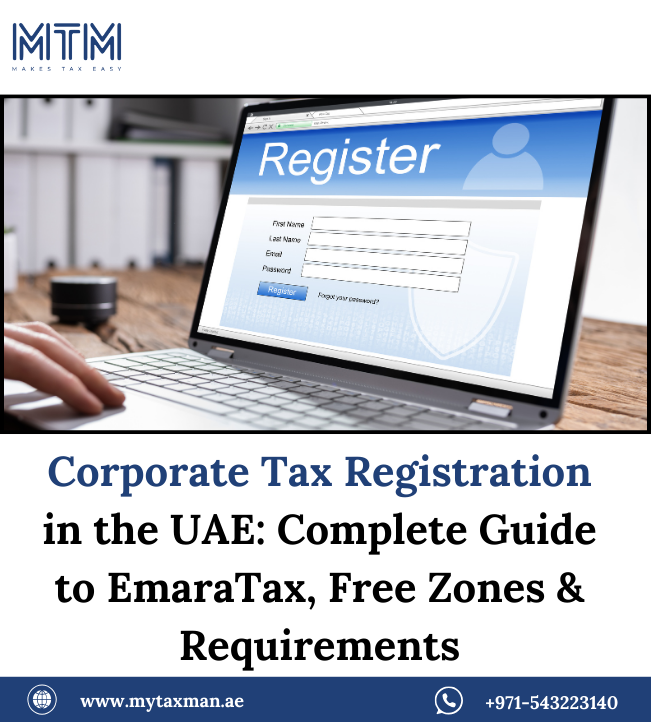
As the new system of corporate tax registration (Federal Decree-Law No. 47 of 2022) is now active in the UAE, knowledge of corporate tax registration in the country is imperative to all businesses, regardless of whether they are located in the mainland or in a free zone. EmaraTax portal forms the compliance channel. This guide will be created by My Taxman and will clarify what corporate tax registration is, who should register, what documents are required, how the registration is performed through EmaraTax, what peculiarities of free zones are required, and what timeframes and results should be expected. With this advice, you will be able to evade fines and stay within the bounds of the UAE law.
Table of Contents
ToggleWhat is Corporate Tax Registration?
Definition & Purpose: Corporate tax registration is a process whereby a taxable entity obtains a Corporate Tax Registration Number (CTRN) issued by the Federal Tax Authority (FTA) of the United Arab Emirates, thus meeting its statutory requirement under the corporate tax law. This is done to make the entity a taxable person under the law.
Legal Authority: Federal Decree-Law No. 47 of 2022, relating to the Taxation of Corporations and Businesses, will take effect on 1 June 2023 and will be applicable to fiscal periods beginning on or after that date.

Who Needs to Register for Corporate Tax in UAE
All Juridical Persons: This group consists of companies registered in the UAE, both on the mainland and in Free Zones. Registration is a mandatory requirement even when an entity is entitled to a 0% percent corporate tax rate on the basis of Free Zone.
Foreign Entities with Permanent Establishment (PE): A foreign-owned business in the UAE that has a PE must be registered.
Natural Persons (Sole Proprietors, etc.): The natural persons may be required to register, depending on the income levels and other factors, in order to conduct business activities in the UAE.
Key Corporate Tax Requirements in UAE
Tax Rates:
- 0 % for taxable income up to AED 375,000;
- 9 % on taxable income above AED 375,000.
Free Zone Entities: Registration is required, even in cases where the rate is 0% under the Qualifying Free Zone Person (QFZP) regime.
To maintain the 0% rate, entities are required to meet the criteria of qualifying income/activity, meet the economic substance criteria, avoid mainland operations (or limit them), and properly classify themselves.
Permanent Establishments and foreign-source income: The income obtained via a PE in the UAE or by designated foreign sources can be subject to taxation with the allowance of foreign tax credits, transfer pricing modifications, etc.
Record keeping: Organizations are required to maintain records, financial reports (audited where required), ownership, business-activity statements, and similar records, usually for seven years.
Transfer pricing and transactions between related parties: Companies must adhere to the laws of the UAE on such transactions.
EmaraTax Portal: Your Tool for Registration & Filing
1.What is EmaraTax? The Federal Tax Authority (FTA) has created an official online platform that allows managing corporate tax registration, tax returns filing, payments, and other activities.
2.How to Register through EmiraTax.
- Register a new account or log in (with EmaraTax; UAE Pass can be used where necessary).
- Select or add the Taxable Person profile.
- Select the option of registering for Corporate Tax.
- Complete entity information: trade licence, legal form, date of incorporation, business activity, financial year dates, authorised signatory, and so on.
- Send the necessary papers (see the following section) and apply.
- FTA processing time : Respond immediately in case more information is demanded.
3.Processing Time & Fees: The registration is free; the estimated time of submission is about 30 minutes, but the official response or final registration number might take more time- maybe up to 20 working days- in case more information is needed.
Documents & Information Needed for Registration
Document Information | Description |
Valid Trade Licence | A current licence which matches the applicable business activity codes, among others. |
Passport or Emirates ID of the authorised signatory | The legal verification is obligatory. |
Memorandum of Association (MOA) | To prove ownership and legal form. |
Evidence of business address | The official address and information on any branches, should there be any. |
Financial statements or accounting records | Help in determining the income, losses and other financial data. |
Authorisation documents | A power of attorney or a resolution, in case of which the application is made by a representative |
Information on business operation and legal structure | To conform to the trade licence and regulatory classification. |
Free Zone Corporate Tax UAE Particularities
Although free-zone entities are supposed to be treated preferentially with a 0% tax rate, they still have to register for corporate tax and file tax returns.
The Qualifying Free-Zone Person (QFZP) status is conditional based on meeting certain requirements, such as demonstration of adequate economic substance, existence of qualifying and non-qualifying revenues, and the lack of any unlawful connections with the mainland businesses that would defeat the free-zone benefit.
Free-zone organizations should be careful when it comes to inter-emirate transactions and mainland sales, and they should make sure that they comply with the UAE corporate tax laws, despite the fact that a 0 % rate applies to the eligible income.
How to Register for Corporate Tax via EmaraTax
Preliminary Preparation: Prepare all the documents as mentioned above and ensure that the trade licence and business particulars are updated.
EmaraTax Account Set up: Open an account or log in and set up the profile of the taxable person.
Full Registration Form: This is where the legal entity, business operations, and the financial year dates are to be given with accuracy.
Upload Documents: Upload PDFs and other necessary documents, making sure that they are clear and the signatures of the rightful owners are properly attached.
Application: Once the application is complete and accurate, submit it. When it is approved, you will be issued a Corporate Tax Registration Number (CTRN).
Monitor / Respond: The Federal Tax Authority can demand clarifications; act in time.
Post-Registration: Ready to file returns, keep the necessary records, and ensure compliance, especially in the case of free-zone entities.
Conclusion
Registration of corporate tax is not a choice anymore it is a legal obligation as per the UAE law. Be it a mainland company, free-zone, or a foreign business operating in the UAE, it is important to learn the corporate tax requirements, use the EmaraTax portal, and prepare appropriate documentation to ensure hassle-free compliance.
My Taxman specialises in assisting companies such as yours with corporate tax registration, transfer pricing, accounting and bookkeeping, due diligence, valuation, CFO services, and raising funding. In case you need professional help to register with EmiraTax, to make sure that your free-zone status qualifies, or just do not want to incur expensive fines, call us now at +971-543223140.We can do the details, and you can concentrate on expanding your business.
Frequently Asked Questions
When is the deadline for corporate tax registration in the UAE?
Before a first corporate tax return is filed, all taxable persons are required to be registered. The law is applicable to the financial periods that begin on or after 1 June 2023. Delays can lead to penalties.
What is the cost of registering for corporate tax in UAE?
Registration through Emira Tax is free. No fee is charged to obtain the CTRN.
Are there any free-zone companies that receive a 0 percent corporate tax rate?
Yes, provided that they qualify as a Qualifying Free-Zone Person (QFZP) in terms of the type of activity, the economic substance, and separation of qualifying income.
What will occur if a company is not registered?
Penalties may apply. The FTA has the ability to give administrative fines. Non-registered organizations might lose their benefit under free-zone regimes or have problems with their operation.
What are the documents to be used when registering for corporate tax?
Trade licence, Emirates ID or passport of the authorised signatory, description of business activity, financial statements, Memorandum of Association (MoA) or similar, address evidence, etc.
What to do after registration for filing corporate tax returns?
After registering through EmaraTax, the businesses have nine months after the financial year to file the return. Apply the EmaraTax portal; prepare supporting schedules, financials, related-party details, etc.